Álbum de Audio Books
|
|---|
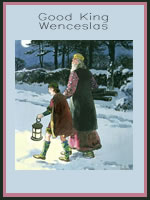
Esta publicação é especialmente destinada ao público infantil interessado no aprendizado da língua inglesa, bem como ao público adulto que deseja aproveitar desse conteúdo. Esta obra é acompanhada de seu texto integral. Este material pode ser apreciado gratuitamente e não se destina ao uso comercial. "Good King Wenceslas"* - Read by Natasha Gostwick. (Duration 18.09 minutes) A bit of history…. King Wenceslas (or Wenceslaus) was the Duke of Bohemia in the years 921-935. He is now patron Saint of the Czech Republic and is statue stands Wenceslaus Square in Prague. His feast day is September 28. The chronicler Cosmas of Prague, writing in about the year 1119, says Rising every night from his noble bed, with bare feet and only one chamberlain, he went around to God’s churches and gave alms generously to widows, orphans, those in prison and afflicted by every difficulty, so much so that he was considered, not a prince, but the father of all the wretched. The episode in our story involving the pagan woman is a bit fanciful, by the way, and not history – although it was a time of conflict between Christians and pagans. The Duke’s mother, Drahomíra, was the daughter of a pagan tribal chief of Havolans and was baptised at the time of her marriage. On Christmas day as was his custom, on this special day every year, Duke Wenceslas visited each of the servants and soldiers in his castle, and pressed a gold coin into his or her hand. The Duke walked through the cold stone passageways in the lower depths of his castle. As he stepped kitchen through the door, a fierce heat struck his face, and the smell of roast meat filled his nostrils. Two servants were turning swans on a giant spit over the fire. Elsewhere men and women, young and old, were busy with fetching, rolling, shouting, stuffing, stirring, scouring, scraping, and all the other tasks of the kitchen. Those who saw him enter stopped their work and bowed deeply. His page called out: “Line up, line up for the Duke.” And the kitchen staff scuffled around arranging themselves in order of rank, from the head cook to the young scullery maid who was just eleven years old. Each of the servants received gold coin from the hand of their ruler with the words: “May the Lord Jesus Christ, our Saviour who was born on this day, bless you and watch over you.” After the kitchen, the Duke proceeded to the guard house, and then to laundry, and then to maids of the bed chambers, and then to the stables. Last of all, he visited the dungeons. The jailers received his blessings and gold, and the prisoners received just his blessings. He spoke last to an old woman prisoner: “May the Lord Jesus Christ, our Saviour who was born on this day, bless you and watch over you.” He looked into the woman’s eyes and saw that they were piercing blue. She must have been quite a beauty in her youth. He felt sorry that her life and folly had brought her to this dark prison cell on Christmas day. “What is her crime?” he asked the Jailor. “My Lord, she is a priestess of the old school. She performed pagan rites and lead the people in the worship of false gods. At this Duke Wenceslas said sadly: “Tis a pity. Had she been guilty of a lesser crime…. had she been guilty of even murder, I would have set her free to go home and to die in her bed among her family.” And then he turned to the old woman: “Do you not see now how the Christian religion teaches mercy and kindness? This Christmas Day I have pressed gold into the hands of the lowliest servant in my castle. Are you not impressed by my good works in the name of Jesus Christ? Do you not renounce the devil and your gods and come to the true Savior?. Only say the words “I do” and you shall be rid of your chains this Christmas Day.” And the priestess lifted her gray head and fixed the Duke with her blue eyes: “The scummiest jailor in your castle is a lord in comparison to peasants outside. You have no idea what it means to live in a hovel, to freeze in depths of winter, to have rags for clothes and a few sticks for a fire. Throw coins to your groveling servants if it makes you feel good before you stuff yourself with rich food. But don’t talk to me of your false charity.” As it was Christmas Day, the Duke did not order the woman to be whipped. He just shook his head at her insolence and her missed chance of freedom. But as he climbed the winding stone stair back to the lighter world of his busy castle, her words were turning in his heart. And when he saw his servants going about their work, briskly, but smiling, he thought “Yes, you are the lucky few.” He no longer felt satisfied with his Christmas routine. He ordered his servant to bring him his fur lined cloak, boots gloves and hat. Another servant strapped a sword to his side. The head stable boy brought his horse out into the courtyard and placed a small ladder against its side. Snow was already flecking the Duke’s beard as he stood and waited for all to be ready. And then he clambered onto his mount and rode through the gates of the castle followed by just a paige on a gray mare. “Boy,” he called back to the page,”Were you born in a village?” “Oh no sire. I was born in the castle,” replied the boy. “Do you have any relatives in a village?” “Oh yes sire. My grandmother lives in a village not far from here.” “Well take me there.” said the Duke. And when they arrived in village, they found the boy’s grandmother at the drinking well, known as the fount of St. Agnes. She was using a long pole – a branch broken off a birch tree – and ramming it down into the well to break the ice. “Here, give the good lady some gold,” said the duke. Which the page gladly did. At this, the other peasants of the village, who until now had been plodding through the snow on their business, came rushing over from all sides to beg the Duke for money. “Back Back!” cried the paige boy. The Duke took a handful of coins and scattered them on the ground. The peasants dived on them like a flock of birds on some crumbs of bread. The duke returned to the castle to resume his Christmas worship and festivities, but instead of feeling better for his generosity, he somehow felt troubled by it. As he celebrated the last Christmas of the millennium, the image of the priestess in the dungeon was always in his mind. The next day – the feast day of St. Stephen – there was boxing and jousting in the tiltyard. Music, dancing and merrymaking continued throughout the afternoon and evening. But the Duke’s heart was still not fully in the celebrations. He stood up from his place in the banqueting hall, and went up onto the ramparts of the castle to take in the cold fresh air. It was a clear moonlit night. He looked out towards the village that he had visited the day before. He saw a peasant wandering across the fields, bending down every now and then to picked up sticks for the fire. “Page, Page!” he called out – for his attendant was never far away – bring me food from from the table, the best bits, and bring wine, and fetch some logs for the fire. I intend to go out and give these things to that man – hurry hurry now. I shall wait for you by the gates of the castle.” The Duke took the winding stairs down to the courtyard. Servants brought him his fur-lined clothes and boots – “No No,” he said. “I shall go without them”. And instead he took off his shoes and stood on the snow covered cobble stones. His feet were entwined in woolen strips – but that was their only covering. The stable boy stood by with the Duke’s horse. “Follow me,” the Duke said to the paige, “We are going on foot.” And seeing that that his master was not wearing a coat or hat, the poor paige felt that disrespectful as he put on his own clothes – but the master did not seem to take notice. The Duke and the boy, walked out through the gates of the castle, their arms filled with gifts. The servants shook their heads, convinced that not only had their Duke gone mad, but that he would catch his death of cold. The peasant was heading for the village, and the Duke and the boy hurried after him. The Dukes almost bare feet sank deep into the snow, but he did not seem to notice the cold. He strode on, propelled by some sort of super-human strength. The poor paige boy felt the chill coming up through the soles of his boot and through his whole body. The wind cut into his face and he rubbed his nose to stave off frost bite. “Sire, Sire,” he called out. “My strength is failing me.” At first the Duke did not hear him. Only when the boy called out: “I cannot go on.” did he halt his progress across the snow. He turned round and saw the boy had fallen to his knees. Duke Wenceslaus looked back to the castle. Although the night had grown darker, he could clearly see his footsteps all the way back. They were luminous like the moon. “Good boy,” he said. “Stand up and place your feet in my footsteps. And paige, who was used to obeying his duke’s every command, gathered his strength and rose to his feet. “Here, here,” said the Duke. “This is my step. Place your foot on top of it.” And the boy, seeing the pale blue glowing footsteps, placed his foot on the spot where thje Duke’s foot and sunk into the snow. Then he lifted his other foot and placed it in the footstep behind. Instead of cold, he felt warmth and energy rising through his body. The Duke carried on ahead, and the boy, followed behind, now feeling as as full of life and energy as if he was striding across a meadow full of lambs one day in spring. The Duke and the paige caught up with the man just before he reached his village. They gave him their gifts, for which he thanked and blessed them. And on his return to the castle, the Duke set the pagan priestess free from the gaol. Good King Wenceslas looked out “Hither, page, and stand by me “Bring me flesh and bring me wine “Sire, the night is darker now In his master’s steps he trod
|